
EU Battery Regulation Information
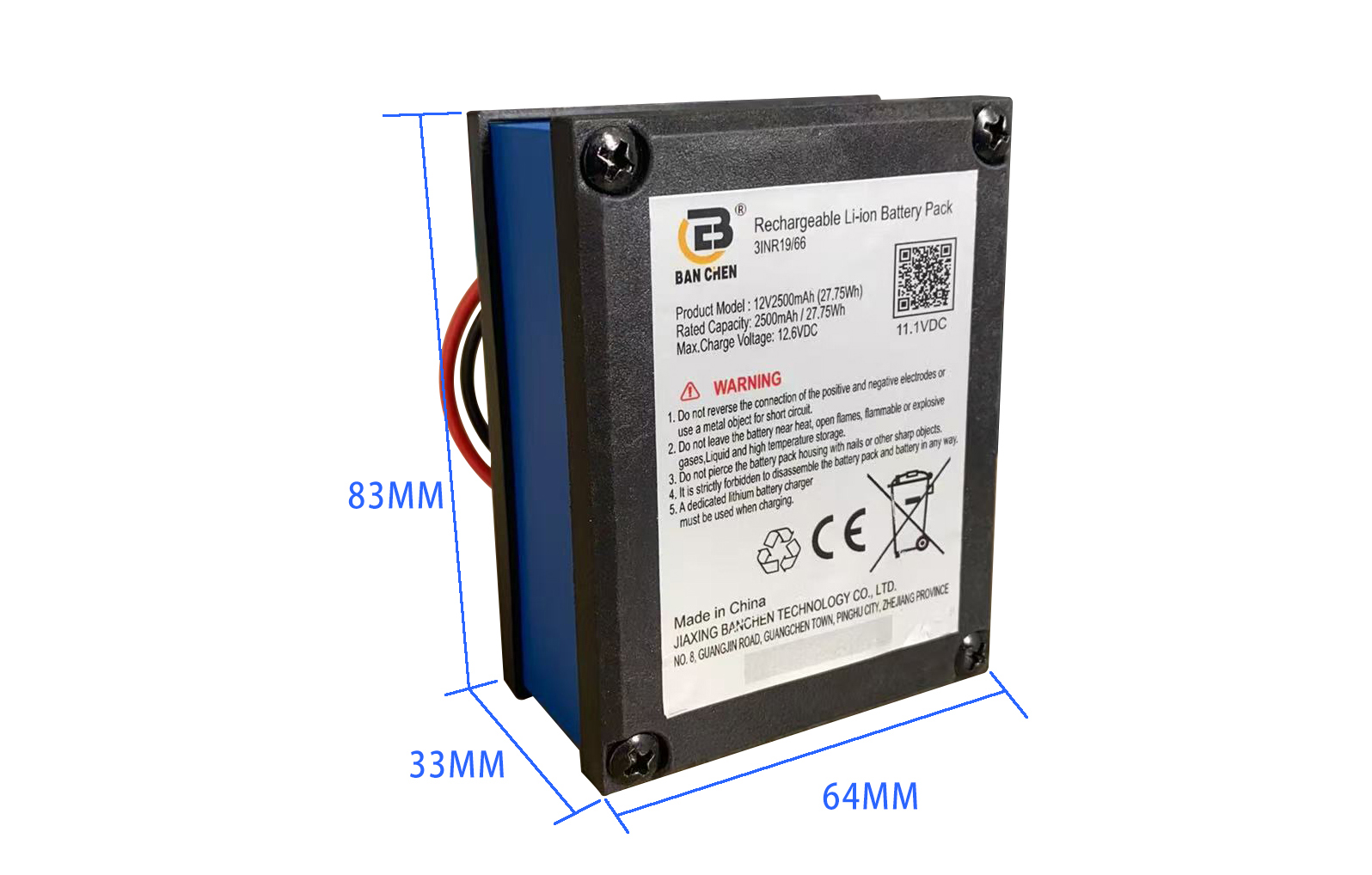
rechargeable lithium-ion battery pack
general Information
- battery Category:portable Battery
- product Name:rechargeable lithium-ion battery pack
- product model:12V2500mAh
- nominal voltage:11.1V
- rated capacity:2500mAh
- maximum charging voltage:12.6Vdc
- nominal energy:27.75Wh
- lot (or serial) number:according to customer requirements, it has been printed on the battery body
- date of production:according to customer requirements, it has been printed on the battery body
- weight:Approx.303g
- chemical system:LI-ION
manufacturer
- manufacturer Name:Jiaxing Banchen Technology Co., Ltd.
- address:No. 8 Guangjin Road, Guangchen Town, Pinghu City, Zhejiang Province, China
- postal Code:314207
- website:https://www.banchenkeji.com
- mailbox:banchentech@163.com
EU Authorized Representative
- on behalf:
- address:
- contact:
- postal Code:
- email:
- telephone:
battery Characteristic Data Sheet
| type | approximate weight (g) | capacity (mAh) | nominal energy |
|---|---|---|---|
| rechargeable lithium-ion battery pack | ≈303g | 2500mAh | 27.75Wh |
Product Picture
hazardous Substances Declaration
this product complies with the European Union Regulation (EU) 2023/1542 appendix I the specified concentration limits of heavy metals:
| mercury (Hg): | ≤ 0.0005% weight percentage |
| cadmium (Cd): | ≤ 0.002% weight percentage (portable battery only) |
| lead (Pb): | ≤ 0.01% weight percentage (portable battery only) |
this product complies REACH Regulation (EC) 1907/2006 Annex XVII applicable restrictions.
this product complies EU POPs Regulation (EU) 2019/1021。
the content of any substance in the REACH Candidate List of Substances of Very High Concern (SVHC) does not exceed 0.1% (mass fraction).
available Extinguishing Agents
signs





Warnings and Precautions
- please use a dedicated lithium battery charger with sufficient capacity to match the battery specifications; when using, be sure to correctly distinguish between the input port and the output port; avoid overcharging and charging in high temperature environments; if there is a peculiar smell, heating, discoloration or deformation during charging, Please stop charging immediately and disconnect the charger.
- When the battery is installed, its ''and'-'polarity must be correct, otherwise the battery may be overcharged or over-discharged.
- Do not short-circuit, heat, throw into fire or disassemble the battery.
- Forced discharge is prohibited, which will cause excessive internal gas generation, which may cause swelling, leakage and explosion.
- When not in use, do not connect the charger or load to the battery pack;
- do not use metal parts to directly connect the positive and negative poles to form a short circuit, otherwise the circuit breaker protection function of the protection board will be triggered. Connect the charger or switching power supply to restore it.
- Danger! Do not place the battery near heat source, open flame, flammable or explosive gas, liquid and high temperature environment, do not immerse the battery in water or make it damp;
- Please keep the battery out of the reach of children to prevent swallowing it by mistake; if an accident occurs, please seek medical attention immediately.
- Do not open, squeeze, heat above (the maximum temperature specified by the manufacturer) or burn this product; strictly follow the manufacturer's instructions for use, and it is strictly forbidden to disassemble the battery pack and batteries in any way.
- Only the battery specified for (battery manufacturer name or end product manufacturer name and part number) can be replaced. The use of other batteries may lead to a risk of fire or explosion;
- it is strictly forbidden to drop, hit, squeeze or puncture the battery, otherwise the battery may explode, catch fire, burn, etc. In the event of an accident, the disposal method is as follows: Please use dry powder to extinguish the fire or a large amount of water to avoid smoke or open fire. After the battery is cooled, it can be transferred to professional institutions or professionals.
- If the battery leaks and the material comes into contact with the eye, immediately rinse with running water for at least 15 minutes and consult an ophthalmologist immediately.
- If the battery emits odor, heat, discoloration, deformation or any abnormal phenomenon during use/storage, please remove the battery from the device immediately and dispose of it properly.
- Do not disassemble or replace the batteries without permission; do not mix batteries of different types, brands or capacities.
- Avoid exposing the battery to extreme heat (e. g. direct sunlight, near a radiator).
lithium-ion battery waste prevention management information
according to Article 74 of the 2023/1542 of the EU Regulation on Batteries and Waste Batteries (EU) (and linking Article 64 of End-User Obligations, Article 8a(2) of the Directive 2008/98/EC). The producer, or the producer responsibility organization entrusted to it, shall provide end-users and distributors with the following information on rechargeable lithium-ion batteries supplied by it in the territory of the Member State:
(a) Role of end-users in waste prevention
follow the device manufacturer's instructions for use and charging to extend battery life. Avoid storing, using or charging in extreme temperature or high humidity environment; Do not put the battery in a fully discharged state when not in use for a long time. It is recommended to keep part of the electricity for storage and regular inspection to prevent over-discharge damage. When the capacity is obviously attenuated, priority should be given to replacing the battery core/maintenance instead of scrapping the whole machine. Batteries can also continue to have value through reuse, reuse preparation, reuse preparation, reuse preparation, reuse, and remanufacturing prior to disposal.
(B) The role of end-users in disaggregated collection (art. 64)
End-users are obliged to separate waste batteries from other waste streams (including unsorted municipal waste) and deliver them to designated sorting collection points set up by producers or their PRO in accordance with Article 59—61 to ensure subsequent treatment and recovery of cobalt, lithium, nickel, manganese, copper and other materials, in line with EU environmental objectives.
(c) Sorted collection, recycling point, reuse/reuse preparation and disposal
waste batteries can be delivered to: retail point collection bins (Distributor's free recycling obligation, Article 62), municipal recycling centers (Article 66), other designated battery collection points. After the collected batteries have been sorted and tested, the reuse/reuse preparation shall be evaluated first (Article 73); those that cannot be used any longer shall enter the treatment process (discharge, crushing, sorting and material recovery, which shall comply with Annex XII).
(d) Safety instructions for the disposal of waste batteries (including the lithium risk statements mandatory under Article 74(1)(d))
lithium-ion battery containing flammable electrolyte, damage, extrusion, short circuit or high temperature may be thermal runaway, fire or even explosion. Do not mix waste batteries with metal objects such as keys and coins. It is recommended to stick the terminals with insulating tape and store them separately. If swelling deformation, peculiar smell or liquid seepage are found, avoid further contact with them, put them into fireproof bags or metal containers and hand them over to the collection point as soon as possible. Do not burn, puncture or disassemble the battery. Keep out of contact with children; if the button battery is swallowed by mistake, seek medical attention immediately.
(e) Meaning of labels and symbols (Article 13 and Annex VI)
(f) Effects of substances on the environment and human health
lithium batteries contain a variety of materials (zinc, manganese, lithium, etc.). If not handled properly (e. g. landfill or incineration), the electrolyte may leak and cause soil and water pollution; heavy metals may accumulate in the environment. Batteries may cause injury if swallowed; keep batteries away from children. Improper disposal increases the environmental burden, wastes recyclable materials, and may cause fire or injury during waste disposal. Leaking batteries may cause chemical burns; handle with care.
This information is provided to support end users in using and disposing of batteries responsibly, in compliance with EU waste regulations.




Declaration of Conformance
the above information complies with the following regulations:regulation No. 2023/1542 of the European Parliament and of the Council of 12 7 2023 on the sustainability, safety and labeling/information of batteries -After evaluation, the battery meets the enforceable requirements of Articles 6 and 13 of the regulation.
Description of Supplier Responsibilities: we understand that the OEM of the device containing the battery or the battery supplied by the OEM as a replacement part in the European Economic Area (EEA) is responsible for preparing the DOC and TDC. As the battery supplier specified in Article 39, we will provide the information in this document to customers as manufacturers as support.
Disclaimer: the above content is the information provided by the company according to the existing product characteristics and EU regulatory requirements. The content may be changed according to the regulatory requirements or changes in product characteristics. The company reserves the right to make any changes to this content without prior notice.